
Edina City Directory Collections, 1941 to 1977
Hennepin County Library digitized the verified Edina run from 1941 through 1977. Those Edina volumes are the strongest starting point for an Edina historical address or a known household name. The online records may show a name, address, spouse, occupation, and a business connection, but the entries are not a census. They usually favor the household head. Minors are generally absent, and women may appear only in a narrower household listing. Treat each Edina result as a dated lead that needs comparison with another record.
| Collection | Years | Where Held | Access |
|---|---|---|---|
| Edina digitized city directories | 1941–1977 | HCLIB collection and portal | Browse and search online |
| Morningside directory collection | 1962–1966 | HCLIB digitized portal for Edina boundary research | Browse and search online |
| Nearby-city directory collections | Hopkins 1942–1977; Lake Minnetonka 1941–1977; Minneapolis 1859–1955; St. Louis Park 1933–1977 | HCLIB portal for an Edina-area search | Browse and search online |
| Hennepin directory collection | 1859–1983 collection description; Edina subset not separately dated | Minnesota Historical Society for Edina research | One name or business, up to five years, $5 processing |
| Directories, maps, and clippings | Dates vary | Hennepin History Museum and Edina Historical Society | Edina appointment or research-library visit |
The verified digitized span is an Edina collection span, not proof that every year or every person is present. The research did not verify a publisher for each Edina volume, a complete reverse-directory shelf, or the last printed Edina issue. Record the Edina volume year and image number before drawing a conclusion.
Finding Edina Directory Images
The HCLIB digitized-directory portal has simple search, browse, and sort controls. Use a case-insensitive exact string first for an Edina name or address. The portal accepts * and ? wildcards after at least one character, but not as the first character. It does not support Boolean searching or quotation marks. Its filters include publisher, place, year, month, subject, and collection, so narrowing to Edina or Morningside prevents a useful Edina name from being buried in a neighboring collection.
The HCLIB portal displays the Edina collection controls used for directory searching.
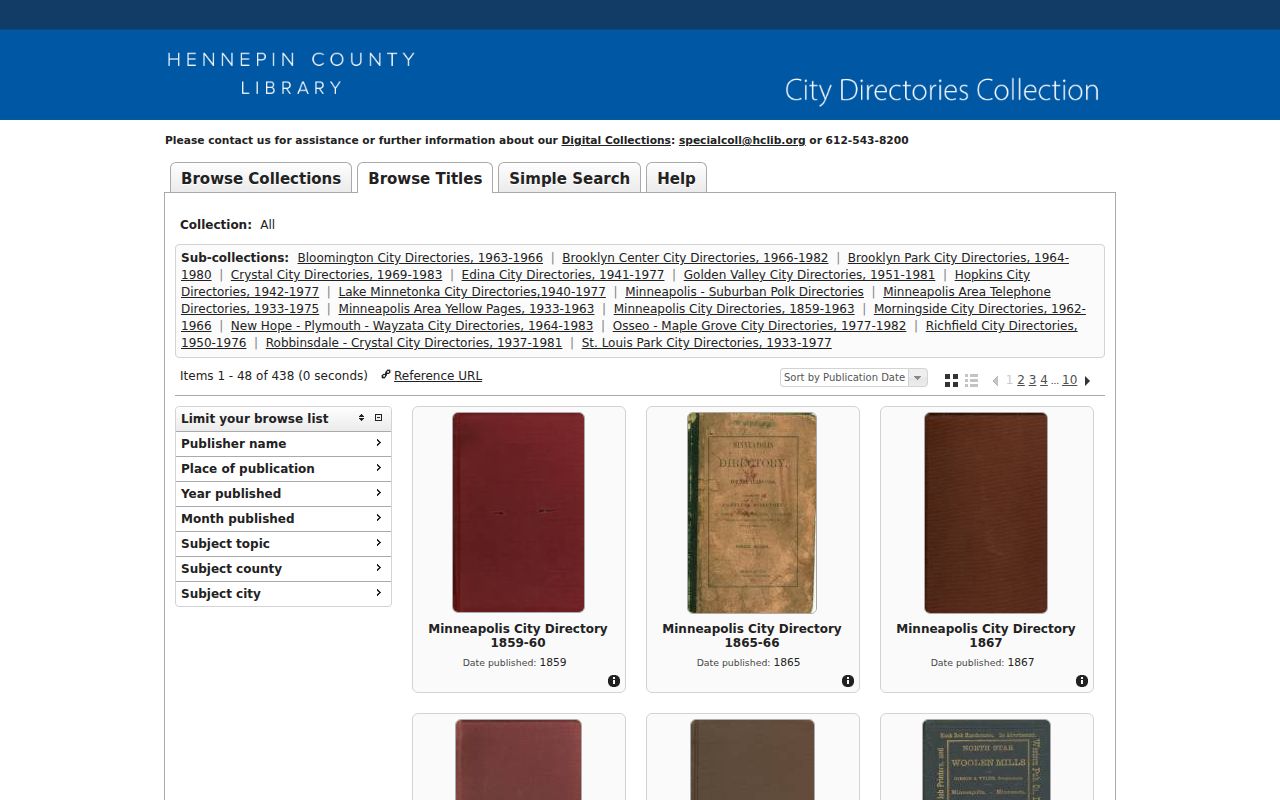
When an Edina name fails, change one dimension at a time: test the address as printed, a spouse or business term, an adjacent year, Morningside, or one of the neighboring collections. Preserve the exact Edina spelling, place, directory year, page or image, and whether the result appears to be a household or business entry.
Note: A directory no-match defines only the searched collection, term, and year, not whether a person or household existed in Edina.
Edina Archive Visits for Directories
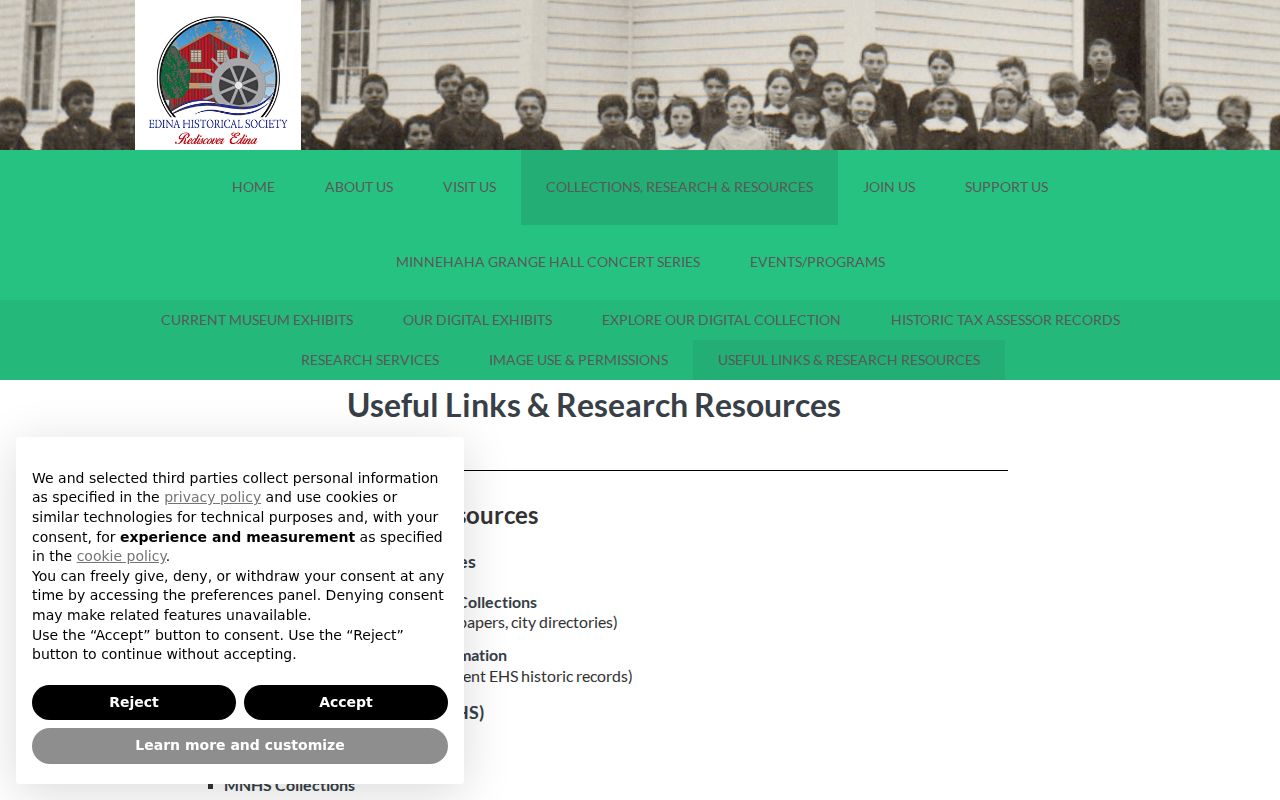
For an Edina question that needs paper context, the Edina Historical Society research library is at 4711 W 70th St and lists 612-928-4577. Its posted hours are Monday 4:00–8:00, Tuesday 10:00–8:00, and Saturday 12:00–4:00. The Edina research links point to maps, photographs, old Edina Crier issues, HCLIB, Minnesota Historical Society People Records, Minnesota Digital Newspaper Hub, and other historical sources. These companion sources can help test an Edina move, an institutional name, or a spelling found in a digitized volume.
Edina Historical Society research resources provide local links, hours, and contact details.
The society is especially useful when an Edina item is about a neighborhood, local institution, map, or Crier reference rather than one listing alone. An Edina visit does not turn a directory entry into a full account of a household, but it can supply the source trail needed to check it.
The Hennepin History Museum archives are another in-person Edina research channel. Research is by appointment, and the archive identifies historical directories, maps, Sanborn maps, clipping files, photographs, letters, blueprints, diaries, yearbooks, and county reference materials among its holdings. Exact Edina Sanborn years were not verified, so ask the repository for its Edina date range rather than assuming a particular sheet exists.
The Hennepin History Museum archives describe appointment research and its directory, map, and clipping holdings.

Bring the directory year, image number, names as printed, and the address as printed. That small source log makes it much easier for an archivist to help locate a related map, yearbook, newspaper, or clipping.
Reading Edina Directory Entries
An Edina historical directory entry is best read field by field. An Edina name gives one version of identity for that year. The address anchors the listing in place. A spouse, occupation, or named business can help separate people with the same name. None of those fields establishes present residence, and not every volume contains every kind of detail. Start by transcribing what is visible rather than expanding an abbreviation from memory.
| Name | Spelling as printed, often centered on a household head or business. |
|---|---|
| Address | Street address as printed for that directory year. |
| Spouse or household clue | May identify a relationship within the narrower listing style of the volume. |
| Occupation or business | May give an additional identity clue or an organization tied to the entry. |
| Collection metadata | Place, publication year, title, publisher, subject, query, and page or image. |
- Criss-cross directory
- A directory arranged by address or street rather than alphabetically by name. A verified standalone Edina criss-cross shelf was not located, so check the individual volume or repository catalog.
- Householder listing
- A listing centered on one household representative. It can leave out minors and other people at the address.
- Abbreviation key
- The volume’s own explanation of shortened labels. Photograph or transcribe it before interpreting the entry.
Edina City Directories and Morningside
Edina municipal boundaries can change the place name attached to a historical listing. Morningside was platted in 1905, became an independent village in 1920, and rejoined Edina in 1966. The portal’s Morningside collection covers 1962–1966, a useful overlap for an Edina household or address that may be labeled differently near the transition. Search both place names when an Edina record seems close but not quite right.
This Edina boundary history also explains why an older map, newspaper item, or directory can use Morningside where a modern researcher expects Edina. Keep the original place label in Edina notes. Replacing it with a current label can hide the route that produced the result.
Trace Edina City Directories by Household
Use a simple year-by-year Edina trail for family history. Begin with the earliest confirmed Edina listing, then move forward one available year at a time. A new street address, a changed spouse clue, or a new business term can be a reason to seek a second source. Pairing directories with the federal census is valuable because census schedules provide household snapshots while the directories fill selected years between them.
- Find a name, address, or business in the earliest available Edina volume and save the collection, year, page or image, and spelling.
- Check the next available year for the same name and address, then note any move or changed household clue.
- Search the address text and an adjacent year when the name disappears or has a likely spelling variation.
- Pair a directory-year result with the nearest released federal census, keeping the census date distinct from the directory date.
- Use newspapers, an obituary, probate material, a map, or a dated city action to test an important change.
A disappearance can mean a move, a death, a listing choice, an address change, or a gap in the available collection. It does not answer which explanation is correct by itself. For modern address-keyed work after the historical trail, use the Edina Street Directory rather than treating a historical directory as a current roll.
Note: Keep the directory image or page number with every transcription so a later reader can distinguish a direct entry from an inference.
Edina Names in Civic History
Edina institutional names can outlast street labels. Minnehaha Grange No. 398 organized in 1873, its hall was built in 1879, and the building served as Edina Village Hall from 1888 through 1942. The hall later moved, reaching Tupa Park in 1970. When an early directory search fails, terms such as Cahill, Grange, Edina Mill, Village Hall, or Tupa Park can lead to city minutes, newspapers, and local-history material that a street-only search misses.
Edina city resolutions, ordinances, and council minutes reach back as far as 1888. They are records of municipal action, not household lists, but they can supply a dated setting for a name or institution found in a historical volume.
Documenting Edina City Directory Gaps
Write down failed Edina searches as carefully as successful ones. Include the collection, place, directory year, exact query, wildcard use, date of search, and whether the result was an image, an index entry, or a page-level hit. That record prevents the same narrow Edina search from being mistaken for a broad negative finding. It also makes a paid Minnesota Historical Society request more precise when a short run needs expert checking.
MNHS offers a one-name or one-business city-directory search covering up to five years for a nonrefundable $5 processing fee. Use it for a defined name and time window, then compare the response against the HCLIB result and local repositories. A paid search is a collection service, not a guarantee that a person appears in a directory.
Edina City Directory Source Notes
A usable Edina directory citation has more than a surname. Preserve the source title, repository, official URL, access date, collection year, query type, exact text searched, and result status. For an Edina hit, add the page or image number, the printed address, the name as printed, and whether the item looks like a household or business listing. For a miss, retain the collection and search term rather than writing only “not found.”
This practice matters when one source uses Morningside and another uses Edina, or when a street spelling changes. It also keeps an index result separate from a scanned image and a finding aid separate from a record. A direct transcription, a guessed expansion of an abbreviation, and a later inference should remain visibly different in the notes.