
Sources for Edina Previous Residents
The backward trail starts with the source that fits the period. A parcel and title record are strongest for a recorded ownership sequence. Digitized directories provide address and household clues for a defined run, while the federal census offers a household snapshot only after its release period. City documents, building records, maps, newspapers, and archive collections add evidence around the address. The table keeps confirmed coverage separate from coverage that the research did not verify.
| Source | Years or coverage | Where held | What it can show |
|---|---|---|---|
| Hennepin deed and title access | PINS recent history: five years; full historical cutoff not stated | PINS, RecordEASE, county computers, and copy routes | Recorded parties, instruments, and document references |
| HCLIB Edina directories | 1941–1977 | Digitized HCLIB collection | Address, name, household, and business context |
| MNHS and Hennepin directory collection | Collection described as 1859–1983; Edina subset not separately dated beyond HCLIB | MNHS request service and library resources | One-name or business research and wider county context |
| Federal census | Released under the 72-year rule; 1950 is the latest public schedule | NARA and official genealogy access | Household, age, relationship, and location snapshot |
| Edina city documents | Resolutions, ordinances, and minutes as far back as 1888 | Edina Docs archive | Named municipal actions and local institutions |
| Building permits and maps | Current ePermits extent and exact Edina Sanborn years not stated | Edina, Hennepin History, and repository leads | Project, building, parcel, or map context |
Start near the date in question. For a recent instrument, use the county title route. For a mid-century address, test the digitized directory years first. For an earlier family question, pair a directory or city source with the census schedule available for that time.
Start Edina Previous Residents With a PID
PINS accepts an address, a 13-digit PID, an addition name, or map selection. Its reported categories include tax information, assessment values, parcel description, sales, and recent documents. For past residents research, write down the PID and legal description before shifting to older records. An address can be restyled, reassigned, or matched to a different postal route. The PID and legal description are the better bridge between a current county result and a recorded instrument.
Hennepin's Property Watch and document-research page also offers a free email alert for a document associated with a property. Sign-up uses an email address plus an address or PID. That is useful for following later recordings, but an alert does not reconstruct the older chain.
The signup view reinforces why both the address and PID belong in a property evidence log. Preserve the record date, access date, and source link beside each result.
Trace Hennepin Deeds Backward
A deed chain is a sequence of recorded instruments, not a complete account of everyone at an address. Hennepin's RecordEASE route supports individual or entity names and legal descriptions. The public index is limited, and RecordEASE Pro is the full-document subscription path. County public computers, mail requests, and copy requests are alternatives when the needed item is not available in the limited index. Use a document or certificate number when requesting a particular item.
- Find the current parcel in Hennepin PINS and record the PID, legal description, and the street address exactly as shown.
- Search the legal description or a verified party name through the Recorder and Registrar of Titles access route. Note the instrument type, document number, and recording date.
- For a purchase instrument, identify the grantee, the party receiving the interest, and the grantor, the party transferring it. Search the earlier acquisition record for the prior recorded link.
- Repeat the documented party-to-instrument check backward, keeping each source separate. Do not infer a full chain from a title alone.
- When the limited index does not answer the question, use RecordEASE Pro, a county public computer, or the county copy and mail route for the identified document.
- Grantor / grantee
- The grantor transfers an interest in a recorded instrument; the grantee receives it.
- Chain of title
- The documented sequence of recorded transfers or related title instruments for a parcel.
- Legal description
- The formal land description used in parcel and title records. It often remains useful when a street address changes.
- Instrument number
- The county document or certificate reference used to identify the item for verification or a copy request.
Move Beyond PINS for Edina Previous Residents
PINS recent recording history reaches only five years and may be incomplete. The county did not state a full historical online-index cutoff, so a missing older result should be treated as an access question, not proof that no instrument exists. Hennepin County describes several recorded categories, including deeds, mortgages, assignments, liens, releases, satisfactions, certificates, and plats. Inspect the underlying instrument before drawing a conclusion from a document title or a party name.
The Hennepin land-title records access page explains the limited public index, RecordEASE Pro, public-computer, copy, and mail options.
For copies, the county lists $1 per page for a plain document and $10 for a certified copy. It lists $2.50 for a recorded document, certificate, or plat. Mail requests go to MC 074, and property owners may use recordsrequest@hennepin.us for electronic deed or certificate requests.
Note: A short PINS history window is a limit on that display, not a verified beginning date for the county's complete land records.
Pair Edina Directories With Census Years
Hennepin County Library's Edina directory collection covers 1941 through 1977. It permits exact strings and * or ? wildcards after the first character, but it does not support Boolean operators or quotation searching. Record the directory year, collection, page or image, spelling, and whether the entry is a head-of-household listing. Directories can contain spouse, address, and business context, but the available information differs by item and should not be treated as a complete household count.
Pair the directory result with the appropriate census release rather than trying to stretch a single entry across decades. The federal census is released under a 72-year rule, and the 1950 schedule is the latest available public census. Start with the directory address as printed, locate the relevant released census year, compare the household evidence, and then return to the parcel and deed trail for a separate property record. The Edina city directory page details the digitized collection itself.
For a gap outside the online run, the Minnesota Historical Society request service offers a paid one-name or business request for up to five years at $5. Its Hennepin collection description reaches 1859–1983, but it does not assign a separate full Edina run beyond the HCLIB dates.
Use Edina Maps as Address Evidence
Current and historic Hennepin section maps, half- and one-eighth-parcel maps, section sheets, historic parcel material, and General Land Office links can place an address in its parcel setting. They are informational maps, not legal surveys. The map route is most useful when a parcel description, plat, or old street form needs geographic context. Keep the map date and sheet reference with the address evidence instead of treating a map label as a title conclusion.
Hennepin's current and historic section-map page is the county route for those map leads.
The county map route can support a parcel comparison, but it does not replace the legal description or recorded instrument. Exact Edina Sanborn-map years were not verified in the research, so check the named repository before assigning a date to a Sanborn lead.
Find Edina House History Leads
Edina's Century Homes program is a strong research lead for an older address. Its application materials call for the address, year built, architectural style, original owner, researcher, a 250- to 1,000-word report, sources, and exterior photographs. Those requirements can point a researcher toward assessing cards, builders, renovation history, and local sources. They do not make the application a complete title chain or a complete list of past residents.
The Edina Century Homes page presents the research and application elements used for this kind of address history.
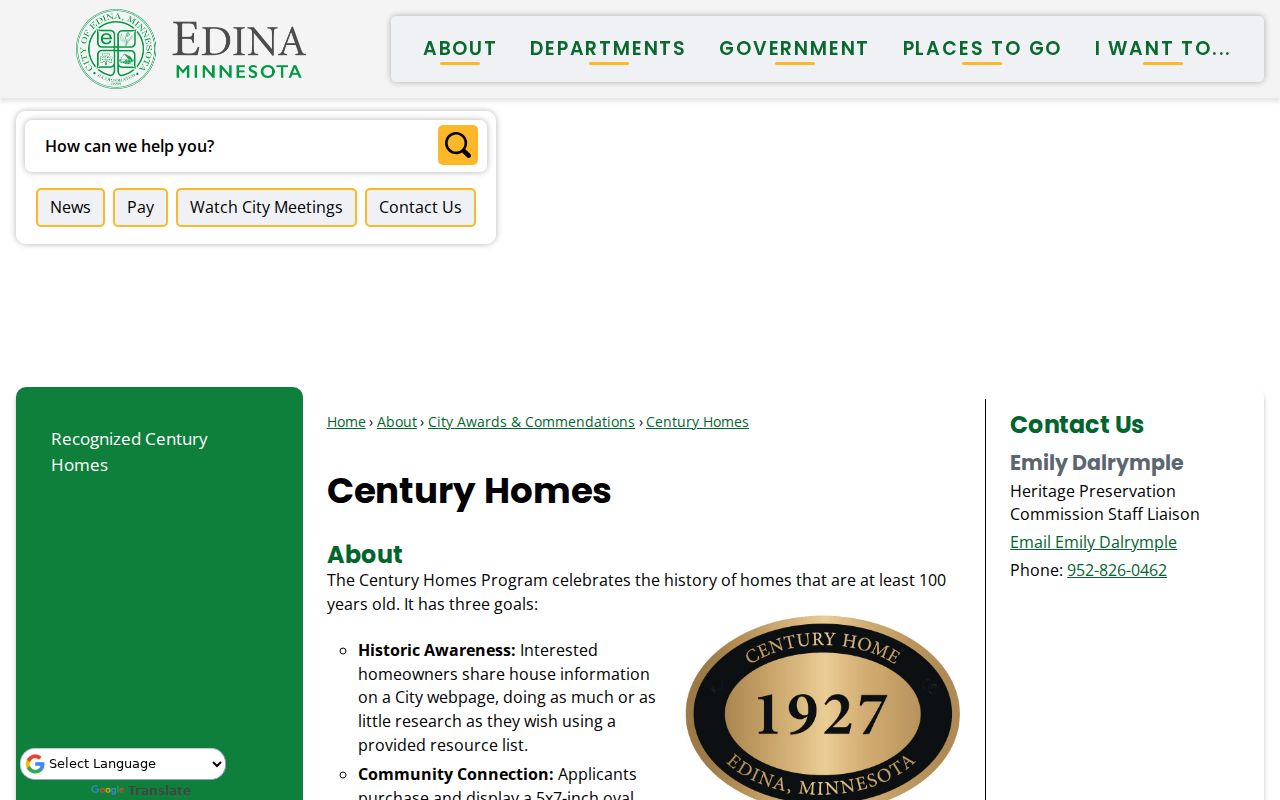
Use a Century Homes lead with the PID, legal description, dated city source, and recorded-instrument trail. That four-part record is more reliable than a story built from one undated mention.
Check Edina Previous Residents at Both Addresses
The 2017 address-assignment memo for a rebuilt corner lot changed 5401 Blake Rd S to 6105 Pine Grove Rd and identifies PID 3211721220037. The distribution list included county, USPS, GIS, utilities, police, planning, engineering, and voter-registration routes. That official example shows why old and new address strings, the PID, legal description, postal ZIP, and directory year should be tested together. An apparent conflict can be a municipal addressing change rather than a gap in the historical trail.
For the earliest layers, institutional names may also matter. Hennepin County was organized in 1852, and Edina documents reach back to 1888. The Cahill, Minnehaha Grange, Edina Village Hall, Morningside, and Tupa Park names can be useful search terms in minutes, newspapers, and archival catalogs when the current street form produces no result.
Close an Edina Previous Residents Trail
When the parcel and directory trail ends, use local repositories to seek a dated supporting source. The Edina Historical Society is at 4711 W 70th St and lists 612-928-4577 for its research links and local-history leads. The Hennepin History Museum archive accepts research by appointment and holds maps, clipping files, directories, photographs, yearbooks, blueprints, and other Hennepin materials. Obituaries and probate records can be useful trail endpoints, but no single complete Edina run was located.
Separate an archive finding aid, an index, an image, a plain copy, and a certified copy in the log. No verified full deed-history cutoff, complete reverse-directory shelf, or exact local Sanborn sequence was found. A careful no-result should name the source, date range, search form, and access route that were actually checked.
Protect Edina Previous Residents Data
Past residents research is appropriate for house history, family history, estate questions, and civic context, but dated records are not proof of a living person's current location or identity. Minnesota Safe at Home protects a designated address for qualifying participants, and protected handling can apply to voter, vital, and court records. Do not publish a protected address or use a partial match to make a claim about a current person.
Minnesota Safe at Home explains the designated-address and mail-forwarding program for qualifying safety-risk participants.
The program information is a reminder to retain only the evidence needed for the historical question and to respect protected-address rules.